
Enter The Andoni-Era
Andoni Iraola doesn't do safe - and that's exactly the point.

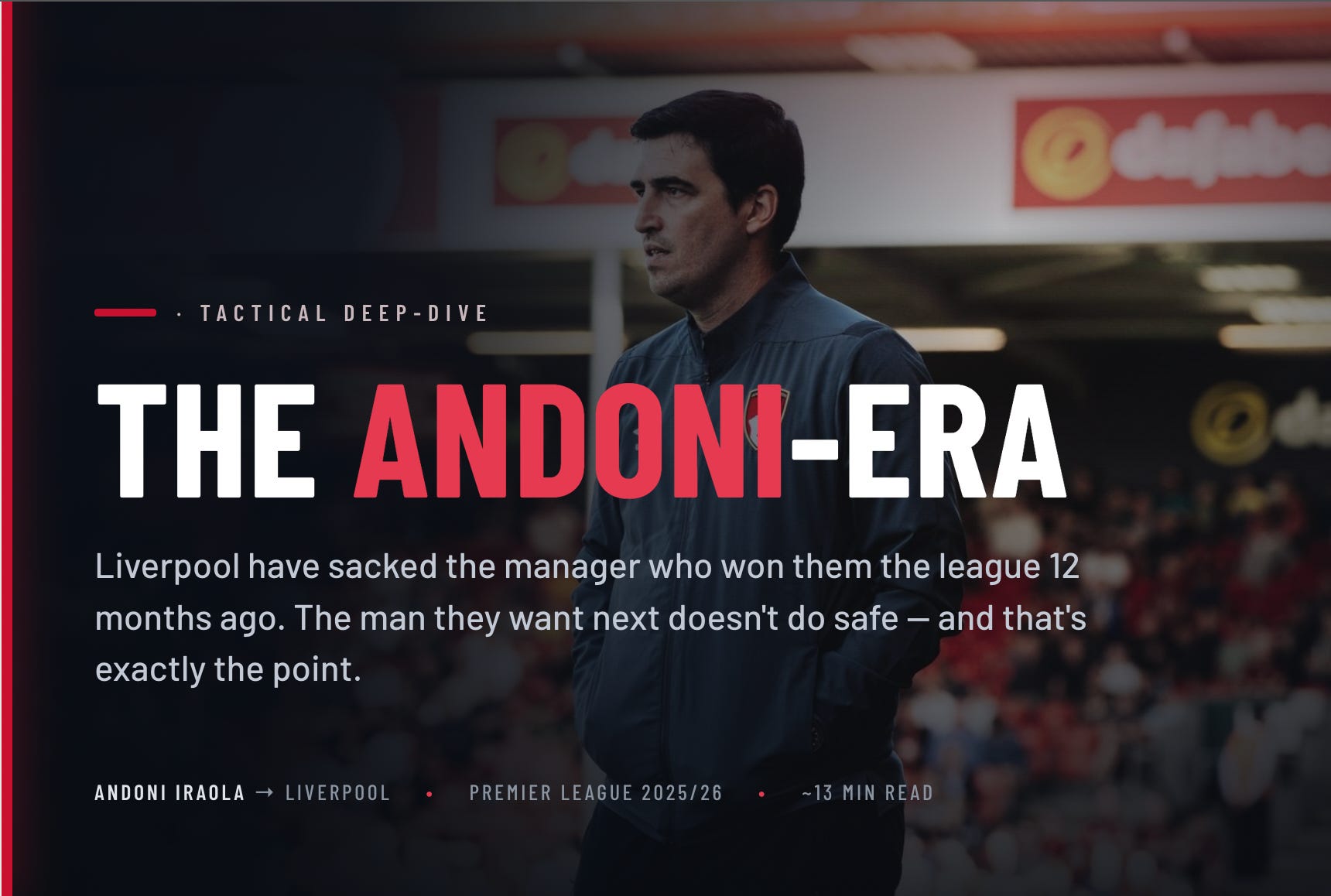
There is no gentle way to frame what landed on Saturday afternoon. Liverpool sacked Arne Slot little more than a year after he was paraded around Anfield as a Premier League-winning manager. A man who, in his debut season in England, delivered the club’s 20th title and was named LMA Manager of the Year.
You can argue the rights and wrongs of it until you’re hoarse, but a sacking is rarely about one thing, and this was a myriad of factors converging at once - a dressing room that had reportedly fractured, a fanbase whose patience had run out, and, underpinning all of it, a style of play.
The football had drifted into something passive and laboured, and at a club built on intensity that was always going to be the fault line. More than any single result, it was the way Liverpool were playing that ultimately cost Slot his job. As Paul Joyce put it:
“Liverpool have decided they need a new manager to give the club the best chance of moving forward with a more front-foot, aggressive and urgent style of football.”
Front-foot. Aggressive. Urgent.
Read that sentence again, then look at who Liverpool have moved for, and tell me this wasn’t a decision made with a very specific replacement already circled in red pen.
Because the man set to walk through the door is Andoni Iraola - and if you wanted to design a manager from scratch to deliver “front-foot, aggressive and urgent,” you’d build something that looks an awful lot like the Basque coach who just took Bournemouth into Europe for the first time in their history.
This is the Ira-era. Let me tell you why I’m so excited about it.
The Philosophy - Respect, But No Fear
Start with the man, because everything else flows from him.
Iraola is, by every account, a fanatic for detail and a zealot for conditioning. This is not a coach who delegates the hard yards. He inherited the Basque obsession with cycling to the point that, during his first Bournemouth pre-season in Marbella, he had the club tune the big screens to the Tour de France while his players ran. Antoine Semenyo, before his January move to Manchester City; admitted that Bournemouth’s players rarely got days off under him. The training is relentless, the standards are forensic, and the demands are physical in a way that the modern game’s more “hands-off” head coaches simply don’t replicate.
If Slot’s reign was eventually criticised for being too light-touch, Iraola is the antidote in human form.
But the conditioning is in service of an idea, and the idea is brave. Iraola wants his teams to attack first and think second. In one of the more revealing interviews he’s given, he explained that he’d often rather see a player carry the ball and force a moment than execute the “correct” positional pass:
“We have to prepare patterns, but we cannot just prioritise them … forget about the pattern, just drive the ball and try to force things to happen. I want him to attack first.”
In a post-Pep era where so much of elite coaching has become about staying in shape - one and two touches, recycle, wait for the structure to crack the opponent open, Iraola has done something close to heretical. He’s handed initiative back to his players and told them to make things happen. He values the dribble. He values the risk. He values verticality over patience.
And it comes packaged with a mentality that should resonate at a club like Liverpool. On facing the giants of the league, his line is one I keep coming back to: you can have respect for the big teams, “but no fear.” Bournemouth, under him, beat Liverpool, beat Arsenal, took points off Manchester City - not by parking up and praying, but by going at them. That’s not naivety. It’s a deliberate refusal to be intimidated, drilled into a group of players who, on paper, had no business going toe-to-toe with the elite.
Pep Guardiola, not a man who hands out praise lightly - has called Iraola’s Bournemouth “completely alive, aggressive, and well organised,” and gone as far as to say that the way Bournemouth play is the direction modern football is heading. When the most influential coach of the era is using your team as the reference point for where the game is going, you are doing something right.
The System - What He Actually Asks Of Players
Philosophy is nice. Let’s talk about the machine.
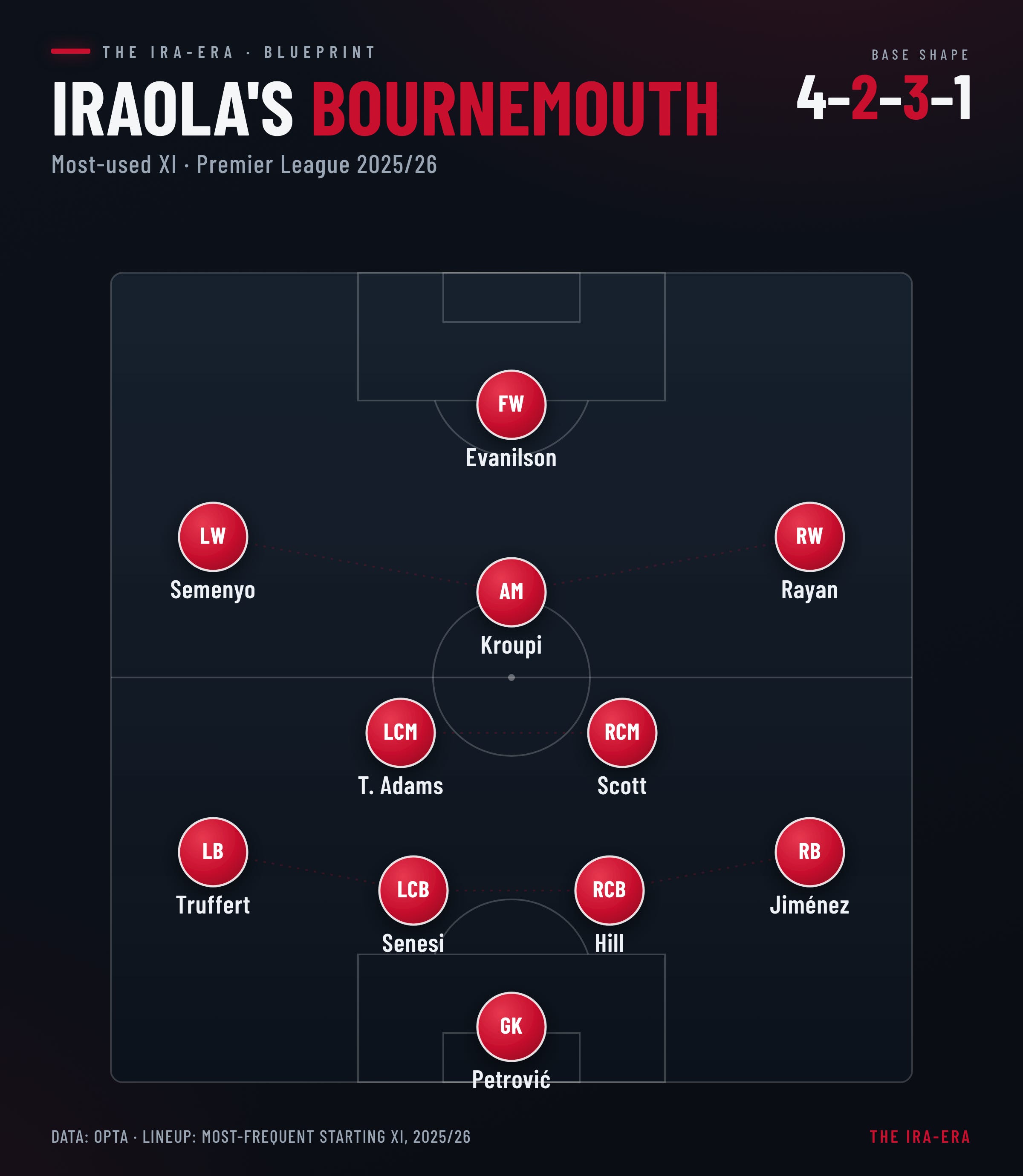
Iraola’s nominal shape last season was a 4-2-3-1, though the truth is messier and more interesting than any single formation graphic can show. In the press it routinely flexed toward a 4-1-3-2 / midfield diamond that could collapse into a flat 4-4-2 when forced deep. The shape is a starting point, not a cage.
Out of possession - the hybrid press: This is the signature. Bournemouth don’t press like the early-Klopp gegenpress of pure chaos; they press like a trap. They begin in a zonal block designed to choke off central routes, with the striker making a curved run to shepherd the goalkeeper into playing wide to a centre-back. The moment the ball travels to one side, the trigger fires and the whole unit jumps man-to-man, hunting in packs, with the wingers tucking in narrow to protect the centre and the far full-back deliberately left as the “free” man because he’s the hardest pass to reach. Crucially, Iraola instructs his centre-backs to follow dropping forwards aggressively - high-risk, high-reward defending that most managers wouldn’t dare coach.
Get this right and it suffocates teams. Get it wrong: as Bournemouth did in Iraola’s first months, when the players hadn’t yet internalised the triggers - and it leaks badly. The whole system is a coaching project that takes time. Hold that thought; we’ll need it later.
In possession - vertical, direct, fast: The first instinct on winning the ball is to “play to the number nine,” because that’s the moment the opponent is least organised and the spaces are biggest. Bournemouth don’t dominate the ball — they had 50.1% possession last season, almost exactly league average — and they don’t want to. They want to go through you, not around you. Roughly 35.5% of their passes went forward, among the most vertical in the division, and they attacked at an average of 1.88 metres per second - among the quickest upfield movement in the league. Attacks are funnelled down the wings, with full-backs flying forward and wingers drifting inside into the half-spaces.
The transition game. This is where the press and the verticality fuse into one weapon. Win the ball high, hit the nine, get bodies into the box before the opponent can reset. And here’s the underrated part that pundits routinely miss: a high-pressing team should be vulnerable to counters the other way - yet Bournemouth were among the hardest sides in the league to break in transition, because the zonal foundation and the screening midfielder mean they’re rarely as exposed as the risk profile suggests. It’s aggression with a safety net.
The player asks are brutal and specific. Full-backs must defend one-on-one and provide the entire width going forward. Wingers press like auxiliary midfielders and create like forwards. The double pivot - Tyler Adams the relentless screen, Alex Scott the carrier - has to cover acres, win second balls from goal-kicks, and spring the break. And the striker (Evanilson) is the trigger man for the whole press and the first option in transition. Nobody hides. Nobody coasts. That’s the deal.
The Season - A Record-Breaker, By The Numbers
Let’s reaffirm all of the above with the receipts, because Iraola’s final Bournemouth season wasn’t just stylistically pretty - it was historically good.
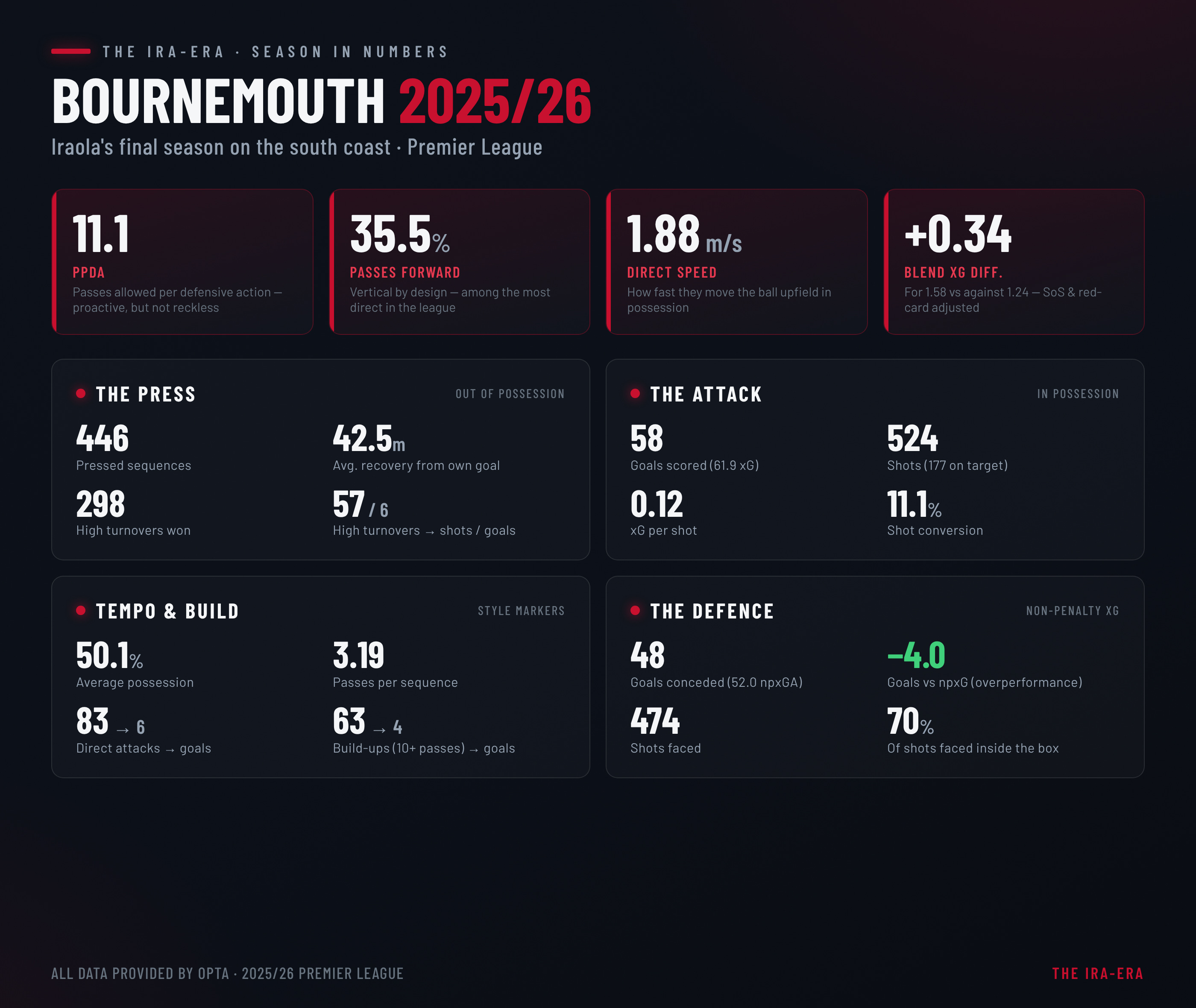
A sixth-place finish - the highest in the club’s history, breaking the points record he’d already set in each of his three seasons there. Europa League football for the first time ever. And an 18-game unbeaten run to close the campaign: the longest single-season unbeaten streak by any side in the Premier League this year, and the first time a team outside the established “big five” has managed it in the Premier League era. He did all of this after the club sold four of its first-choice back five last summer - Huijsen, Kerkez, Zabarnyi, Kepa - and then cashed in on his top scorer Semenyo in January. They should have fallen apart. They got better.
The underlying numbers tell the story of the identity:
PPDA of 11.1: proactive without being reckless, backed by 446 pressed sequences and an average recovery 42.5m from their own goal. They won the ball back 298 times high up the pitch, turning 57 of those into shots.
An attack that generated 61.9 xG from 524 shots: note they actually under-performed their xG slightly (58 goals scored), which hints at a finishing ceiling that better personnel could raise.
The clearest fingerprint of the lot: direct attacks (83, producing six goals) out-scored slower build-ups of 10+ passes (63, producing four). This is a team that hurts you fast, not a team that strangles you slowly.
And a defence that over-performed: 48 conceded against 52.0 non-penalty xG, a tidy −4.0, with 70% of the shots they faced coming from inside the box - they don’t give up clean central looks easily.
If you want the trend lines, the reference charts back the narrative up beautifully:
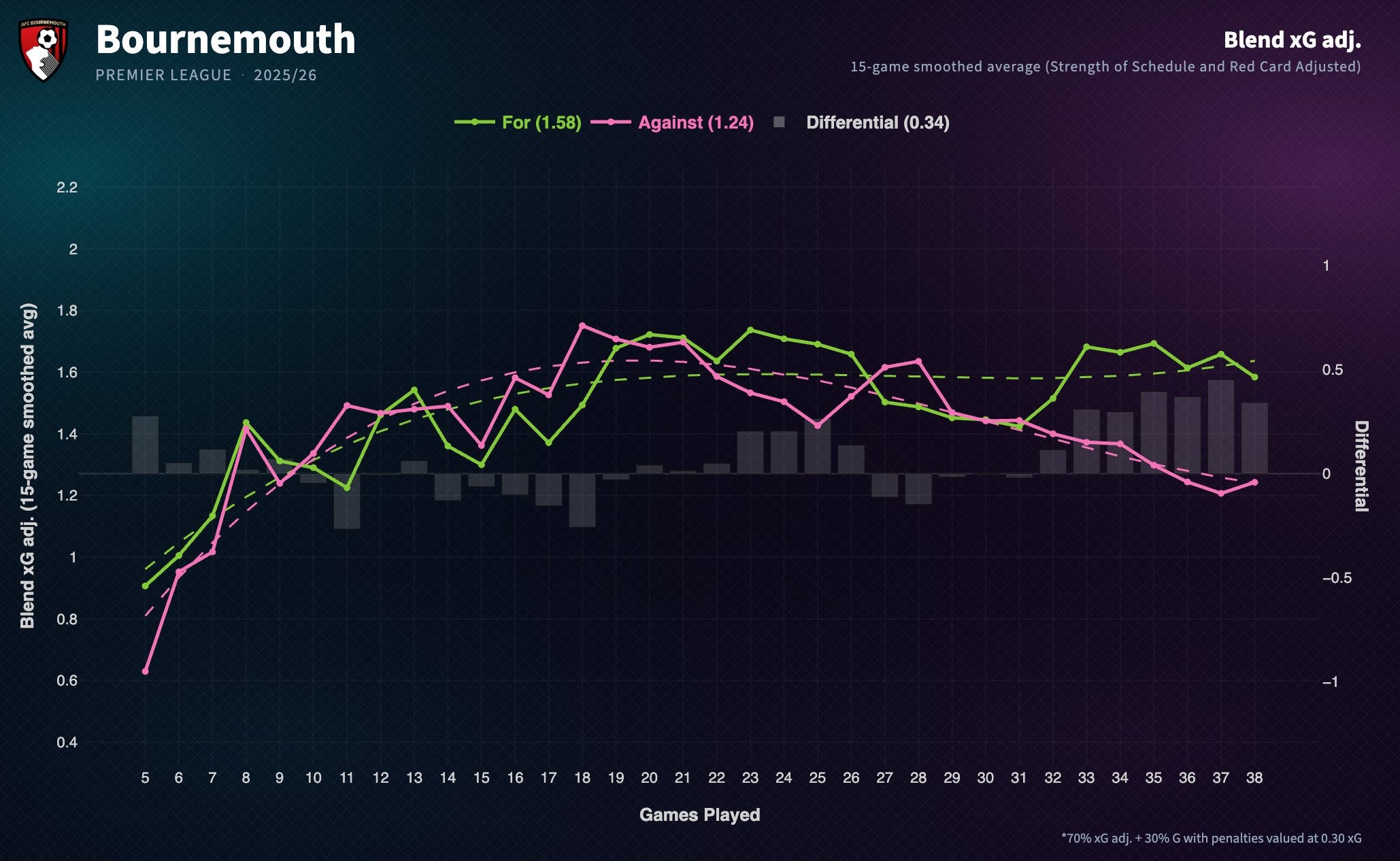
The blend xG-adjusted differential of +0.34 (strength-of-schedule and red-card adjusted) shows a side that finished the season trending upward - that green “for” line climbing and the pink “against” line falling away across the final stretch, exactly mirroring the 18-game unbeaten run. This is not a team that limped over the line; it’s a team that was getting better as the season ended.
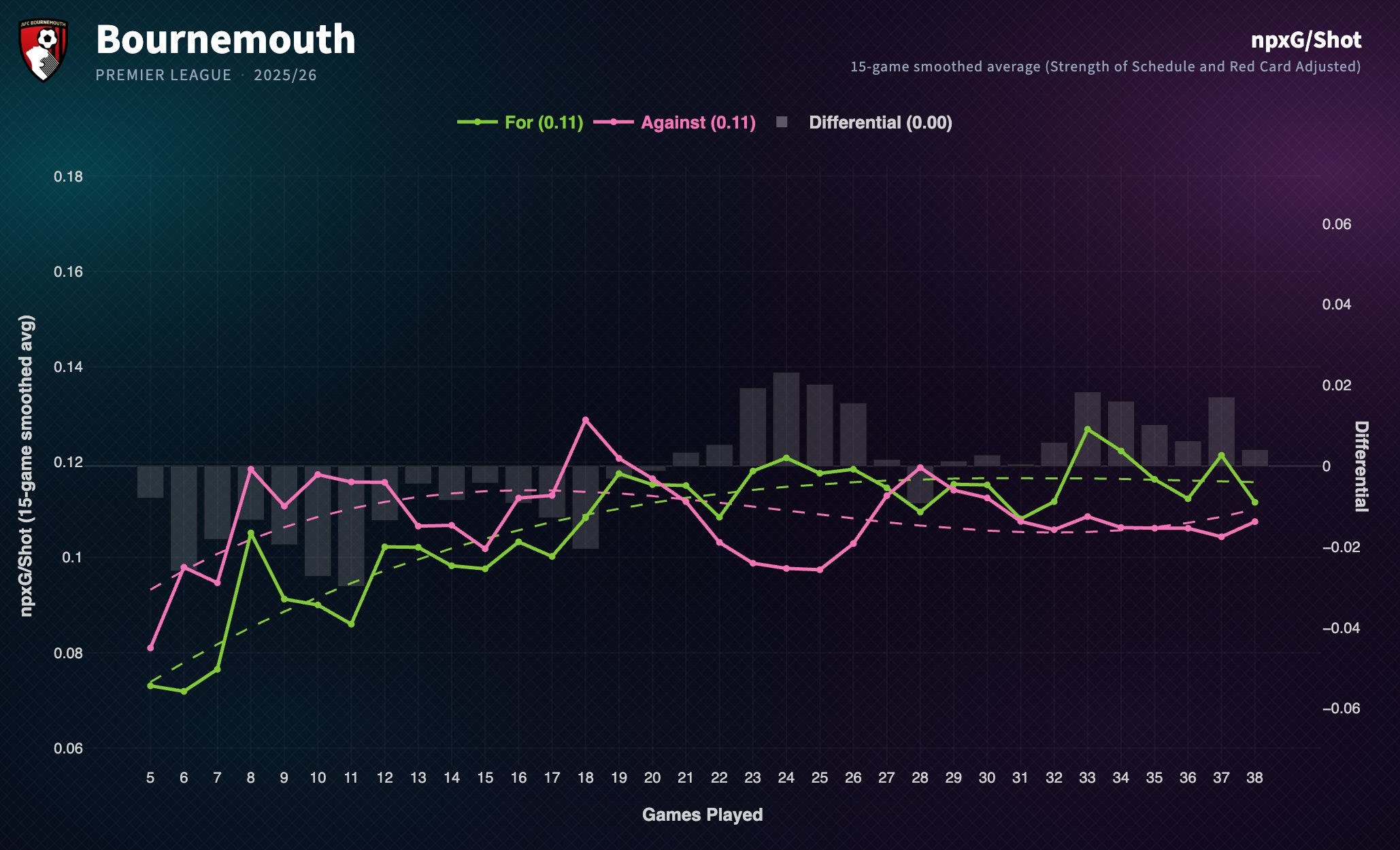
The npxG-per-shot picture is the honest counterweight, and it’s the one I’d flag to temper the hype: Bournemouth’s chance quality - both created and conceded - sat right around league-neutral (0.11 each way). Their edge came from volume and transition, not from manufacturing elite-quality chances per shot. That’s a meaningful distinction when you start imagining this at Anfield (more on that below).
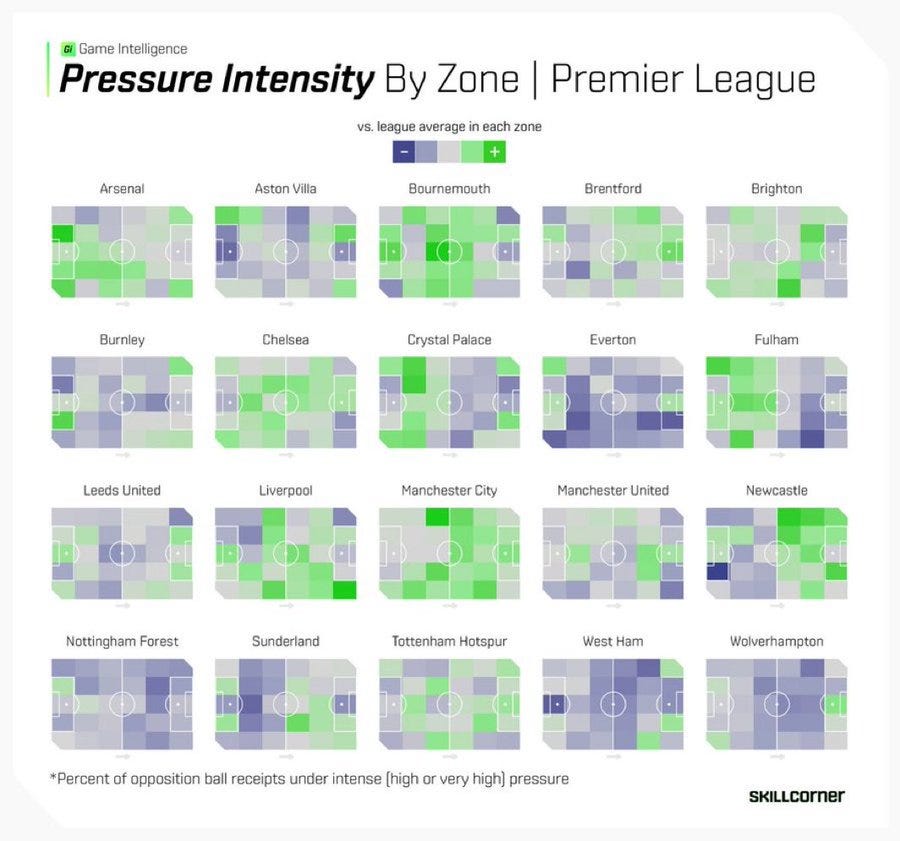
And the SkillCorner pressure map is the visual proof of the press. Bournemouth’s zones light up green — above league average pressure — across the middle and attacking thirds, including the wide high areas where the trap springs. It is one of the most aggressive pressing profiles in the entire division, and it is no accident.
At Anfield - How It Looks With This Squad
Here’s where it gets genuinely thrilling, because - and Opta made this point too … Liverpool are already set up to play this way. They had more shots from fast breaks (51) than any team in the league last season, and topped the division for goal-ending high turnovers. The bones of an Iraola team are already in the building.
The more useful exercise is to take everything above - the hybrid press, the vertical build-up, the relentless running - and ask two questions of this squad: who does the system make better, and what does it expose? Here is, roughly, how it could line up.
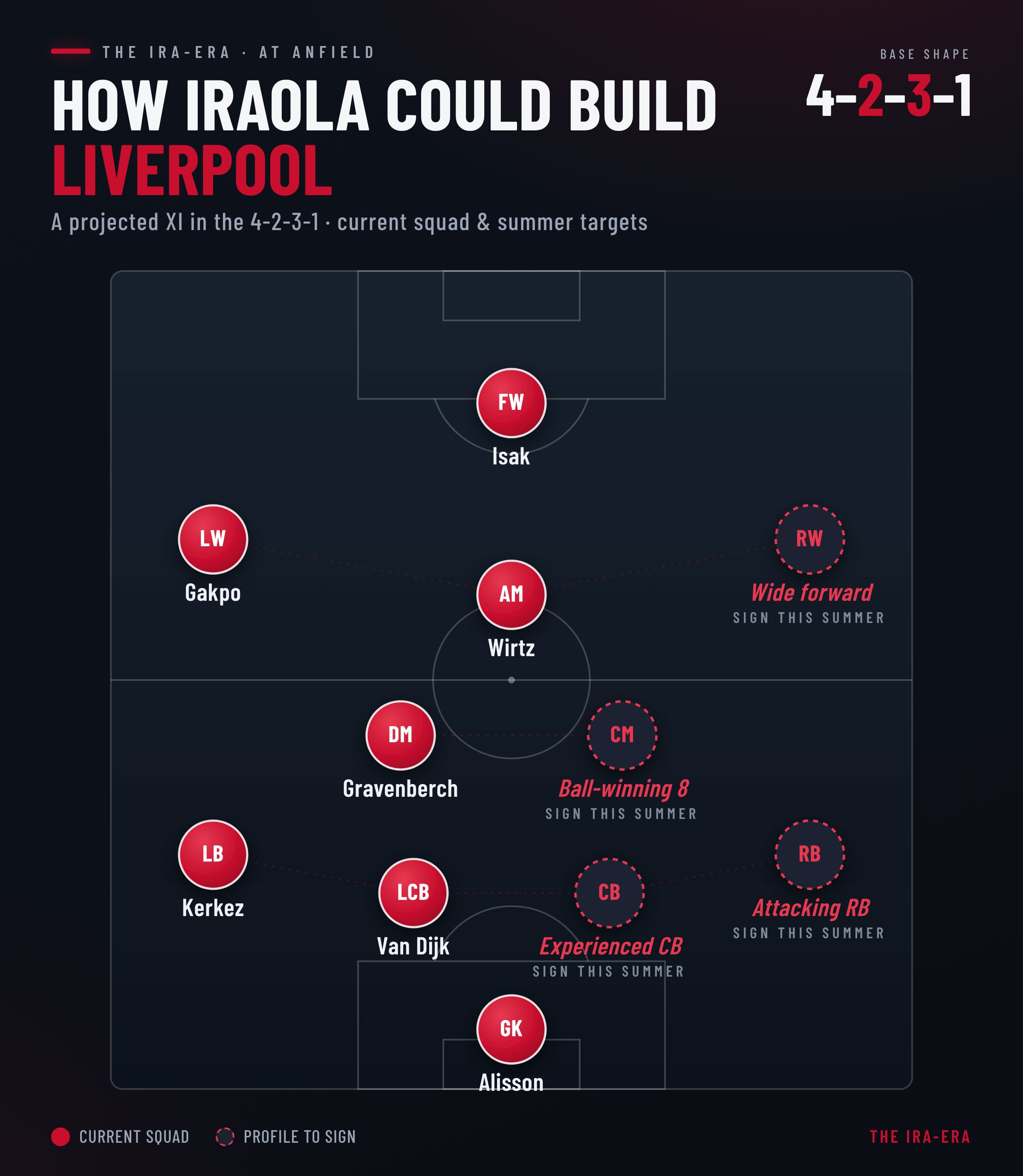
The players who win from this
Ryan Gravenberch is the keystone. A ball-carrying, ground-covering No. 6 who was arguably Liverpool’s best player across the last two seasons — he is tailor-made to be the screening, springing midfielder at the base of this system, the man who lets everyone in front of him gamble. Florian Wirtz is the other obvious winner: handed a free, vertical No. 10 role with licence to “attack first,” he’s a far more natural fit than he ever was as a cog in a slow possession machine - Iraola hands creators freedom, not a script. And Alexander Isak as the trigger nine - the man the press is built around and the first ball in transition - is a more flattering brief than leading a static attack. Both endured difficult, expensive debut seasons; Iraola’s record of getting more out of misfiring talent is the single biggest reason to believe they bounce back.
Milos Kerkez might be the neatest fit of all. He’s already at Liverpool - and Iraola developed him at Bournemouth. The new manager inherits a flying, system-literate left-back who already speaks the language; the relentless up-and-down output an Iraola full-back has to produce is exactly what Kerkez was built for. Behind him, Dominik Szoboszlai’s engine and pressing appetite map neatly onto the running demands of this midfield.
The build-up - the area that quietly broke last season. This is where I think Iraola can fix something Slot never did. Liverpool’s first-phase build-up was a problem all year: losing Trent Alexander-Arnold — one of the great progressive passers and the man who set the tone of the first phase — left a side that too often struggled to play out cleanly and progress the ball with any control. Iraola’s answer isn’t to turn Liverpool slow and possession-obsessed; it’s structure with purpose. His sides build from a defined shape - a screening pivot dropping in, full-backs giving height and width, centre-backs comfortable being pressed - but the intent is always to get vertical the moment the picture opens. The structure exists to create the forward pass, not replace it. A Gravenberch-anchored first phase, a genuine progressive right-back, and a vertical outlet in the nine hand Liverpool a build-up identity again - one that travels forward instead of sideways.
The four profiles Liverpool must sign
Now the honest part, because that projected XI cannot be filled by the players currently on the books. The system - and a brutal summer of departures - leaves four clear gaps. The encouraging thing is that most were already near the top of Liverpool’s list before the manager even changed.
An experienced centre-back. This is now arguably the most urgent job on the list. With Ibrahima Konate leaving on a free and Joe Gomez’s future uncertain, Liverpool are staring at a back line built around a 34-year-old Virgil van Dijk and two highly-rated but young, currently-injured centre-halves in Giovanni Leoni and Jeremy Jacquet. Iraola’s defence is asked to hold a high line and defend huge spaces one-on-one — that is no place to throw raw youth in cold. Liverpool need a ready-made, senior centre-back who can play on the front foot next to Van Dijk and share the leadership load while the kids develop. Not a project. A starter.
An attacking right-back. Iraola’s full-backs provide the team’s entire width and spend their lives overlapping - and the right side is unresolved. Jeremie Frimpong was bought and then miscast as a winger, and I’m not convinced he’s the answer to what this system actually needs. The brief isn’t a sprinter shoved infield; it’s a genuine, two-way attacking full-back who owns the flank - relentless on the overlap, comfortable arriving in the final third to deliver, and disciplined enough to defend his one-v-one when the press is bypassed. The right-back you’d build for this team looks a lot like the one Iraola had at Bournemouth: chalk on his boots, end product, lungs for days. That’s a genuine recruitment priority, not a problem you tweak your way around.
A ball-winning engine in midfield. I’ve previously said that Liverpool want “greater physicality in midfield,” and it’s not hard to see why - the midfield looked leggy all season, and Alexis Mac Allister’s lack of raw athleticism in particular was flagged as a problem. Mac Allister is a wonderful footballer, but the every-blade-of-grass running an Iraola midfield demands is the exact profile he doesn’t have, and Wataru Endo has been openly discussed as an upgrade target for over a year. Liverpool need a high-energy, ball-winning No. 8 to sit alongside Gravenberch - pressing on a hair-trigger, covering ground both ways, driving the ball forward the instant it’s won. Get that one right and the spine snaps into place.
A wide forward. The attack has been gutted: Mohamed Salah has gone after a long, emotional goodbye, and summer signing Hugo Ekitike is set to miss most of 2026 with an Achilles injury. Wirtz, Isak and Gakpo give Iraola a serious spine through the middle and left, but the right flank Salah owned for the best part of a decade is now a hole. This system runs on wide forwards who press like demons and attack the box at speed - so the profile is specific: a quick, direct, hard-running wide man who contributes at both ends, not a luxury who only turns up with the ball. Find that and the front four genuinely excites.
None of this is small. But it’s also coherent - four targeted profiles, not a scattergun rebuild, and most of them already on the club’s radar. Land them and the gap between “the squad Iraola inherits” and “the squad Iraola wants” closes faster than the table this season would suggest.
The Risks - Let’s Be Honest
I’m excited. I’m also not going to insult you by pretending this is risk-free, because it absolutely is not.
1 - The intensity question: The big one
This is the concern that keeps surfacing, and it’s a fair one. Bournemouth, for the most part, played once a week. Liverpool will be juggling the Champions League, two domestic cups and a title race, often on a Saturday-Tuesday-Saturday rhythm. Can you really sustain football built on maximal physical output - the every-blade-of-grass pressing, the relentless transitions - when you’re playing every three days for ten months? An identity that wins points across 38 fixtures is a different proposition stretched across 55+. The squad has to be deep enough, and conditioned enough, to carry it without the wheels coming off in spring — a genuine open question, not a given. It’s also, in fairness, exactly the kind of physical-preparation problem Iraola’s conditioning obsession is built to attack; the worry is the calendar, not the coach’s appetite for it.
2 -The slow start
Iraola did not win any of his first nine games at Bournemouth. The system takes time to coach because the pressing triggers have to become instinctive. Liverpool fans, an owner group, and a fanbase that just sacked a title-winner for going stale will not have the patience that Bournemouth - a club with nothing to lose - could afford. If September is rocky, the noise will be deafening. The club has to hold its nerve in a way it conspicuously failed to this past year.
3 - Chance quality, not just chance volume
Remember that npxG-per-shot chart sitting at league-average? At Bournemouth, transition volume papered over ordinary chance quality. Against deep blocks - which Liverpool will face far more often than Bournemouth ever did, because teams sit in against the Reds - pure verticality can run into a wall. Iraola will need to prove he can break down packed defences with elite players, not just punish open ones in transition. That’s a different test entirely, and it’s the one Slot’s possession game was at least designed to solve.
4 - Possession retention under pressure
Bournemouth were, by their own data profile, one of the worst sides in the league at keeping the ball under pressure - a deliberate by-product of the risk-it-forward approach. At a club expected to dominate the ball most weeks, that trade-off needs careful recalibration.
None of these are reasons not to do it. They’re the things that have to go right for it to work - and they’re the reasons this is a bold appointment rather than a safe one.
The Verdict: Bring On The Ira-Era
Here’s where I land, and I’ll nail my colours to the mast.
Liverpool had a choice. They could have hired safe, steady pair of hands to stabilise a wobbling ship and manage the decline gracefully. Instead, they’ve gone for the most exciting young coach in the league: a relentless, detail-obsessed, fearless tactician. They’ve hired a man Richard Hughes knows intimately from their Bournemouth days, who plays exactly the “front-foot, aggressive and urgent” football the club has publicly said it wants, and who has a proven, repeated record of making players better and beating the giants without fear.
Yes, there are risks. The intensity across a brutal calendar, the patience required for a slow burn, the rebuild he’s walking into, the question of whether transition football scales against deep blocks with the weight of Anfield on it. I’ve laid them out honestly because they’re real.
But I keep coming back to that mentality - respect, but no fear - and the thought of it being poured into a squad with Gravenberch’s legs, Wirtz’s imagination, Isak’s movement and Kerkez already fluent in the language. Get the midfield engine right this summer and this could be the most fun Liverpool have been to watch since the heavy-metal years.
I didn’t want safe. I wanted alive. And on the evidence of three record-breaking years on the south coast, alive is exactly what Andoni Iraola brings.
Welcome to the Andoni-era. I can’t wait.
We need to get back Darwin. As the sub 9. To be the focal point of attacks. And man can run like a dog.
Interesting and thought provoking article. Thanks. I'm interested to know why you think gakpo is any more suitable than say Jones for this new system. He stunk out the joint all season and proved he can't take on a man in the way that semenyo or Rayan could. He's not fast, not explosive and the only skill move in his arsenal is the cutback and row Z shot. Either way it's clear the squad needs additions who are able to suit iraola's system